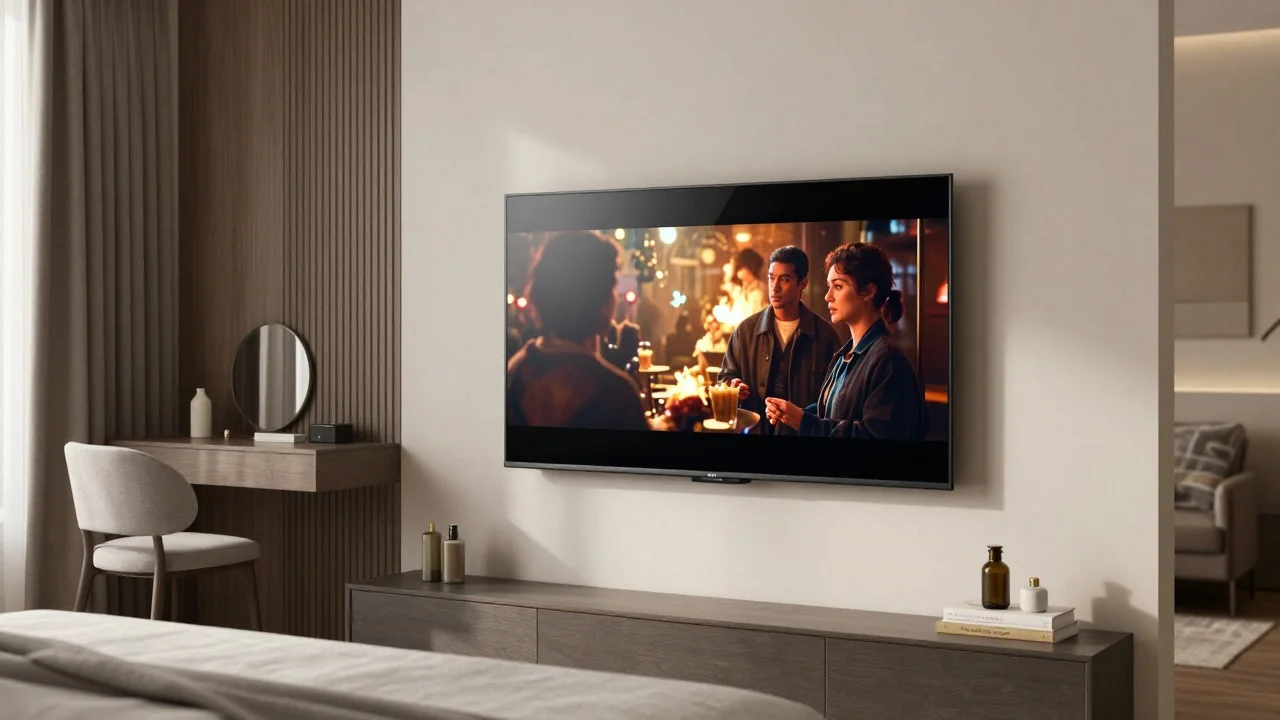
A 32 inch TV remains one of the most practical choices for a bedroom, dorm, kitchen, guest room, RV, or compact home office. While the TV market increasingly focuses on 55-inch and larger screens, smaller televisions still make sense when space, viewing distance, and budget matter more than creating a home-theater experience. The challenge is knowing which specifications actually improve a 32-inch screen and which features are worth paying extra for.
US buyers can currently choose between inexpensive HD sets, sharper 1080p models, and a small number of premium 4K televisions. Smart platforms such as Roku TV, Google TV, Fire TV, and Samsung Tizen also make these compact models useful without a separate streaming device. This guide explains the best current options, real dimensions, resolution differences, viewing distance, connectivity, gaming potential, and the features worth checking before you buy.
Quick answer: A 32 inch TV is best for bedrooms, kitchens, dorms, offices, RVs, and other small spaces. For most buyers, 1080p Full HD offers the best balance of sharpness and price. Choose the smart platform you prefer, confirm the number of HDMI ports, and measure the complete TV, not just its 32-inch diagonal screen, before ordering.
Best 32 Inch TV Options at a Glance
| Model | Resolution | Smart platform | Best for | US pricing reference |
|---|---|---|---|---|
| Roku Select Series 32-inch FHD | 1920 × 1080 | Roku OS | Best value for most buyers | Roku lists the 32-inch FHD model around $119.99 at the time of research. |
| TCL S350G 32-inch | 1920 × 1080, HDR10 | Google TV | Google ecosystem and casting | TCL lists a $199.99 suggested price. |
| Amazon Ember/Fire TV 2-Series 32-inch | 1280 × 720 | Fire TV OS | Alexa and Fire TV users | Retail price varies; the 2025 model remains supported with security updates through at least December 2030. |
| Samsung Q8F 32-inch | 3840 × 2160 QLED | Tizen | Premium picture and close-up use | Samsung lists the 32-inch Q8F at $499.99, although retailer pricing can be lower. |
Prices and availability were checked for the US market in September 2026 and can change.
Is a 32 Inch TV Still Worth Buying in 2026?
A 32-inch TV is still worth buying when the room and viewing position suit a compact screen. It works especially well where a larger television would dominate the furniture, obstruct cabinets, or place the viewer unnecessarily close to a big display. Current 32-inch sets also include mature streaming platforms, wireless connectivity, voice remotes, and enough inputs for common devices.
The main compromise is that manufacturers reserve many premium display technologies for larger screen sizes. Most affordable 32-inch televisions are still HD or Full HD, and built-in speakers tend to be modest compared with larger sets. Current buying guides similarly show that 720p and 1080p remain common at this size, while genuine 4K choices are relatively unusual.
For a secondary room, that compromise can make excellent financial sense. Spending several hundred dollars on advanced local dimming, extreme brightness, or high-end surround processing may offer little benefit when the television is primarily used for news, casual streaming, YouTube, or an occasional game. Put the money toward the features you will actually notice every day, particularly resolution, software responsiveness, ports, and reliable Wi-Fi.
Best 32-Inch TV Choices for US Buyers in 2026
No single television is ideal for every buyer because this category covers everything from inexpensive bedroom screens to unusually capable premium models. The strongest choice depends on whether you prioritize price, streaming software, picture sharpness, voice control, or gaming. These four models illustrate the most useful buying paths in the current US market.
Roku Select Series 32-Inch FHD: Best Overall Value
The Roku Select Series FHD model is a sensible starting point for shoppers who want a straightforward 32-inch TV without paying for unnecessary extras. Roku offers a 1080p version with its familiar Roku OS, Dolby Audio, Bluetooth, dual-band Wi-Fi, a voice remote, and three HDMI connections when the ARC input is included. The official specification also lists a 200 × 200 mm VESA mounting pattern, making wall mounting relatively simple with a compatible bracket.
Its biggest advantage is balance rather than one spectacular specification. Full HD is sharp enough for close bedroom viewing, Roku OS is easy to navigate, and the price is competitive with many lower-resolution models. Buyers who simply want streaming, live TV, and basic external-device support can stop here unless another ecosystem matters more.
TCL S350G: Best 32-Inch Google TV Option
The TCL S350G is a stronger fit for people already using Google services or who regularly cast content from phones and tablets. It combines 1080p Full HD resolution with HDR10, Google TV, Chromecast built in, Bluetooth personal audio, a voice remote, and a 60Hz panel. TCL also provides two HDMI inputs, including one ARC connection, along with USB and optical audio output.
This model can also make sense on a desk because TCL specifically positions it as capable of doubling as a PC display. Full HD gives text and interface elements more definition than a basic 720p panel at the same screen size. If you intend to place it on office furniture, Technoloss’s monitor stand buying guide is useful for checking footprint, height, load capacity, and VESA requirements before changing the display position.
Amazon Ember/Fire TV 2-Series: Best for Alexa and Fire TV Users
Amazon’s current 32-inch 2-Series model is aimed at shoppers who already use Alexa, Prime Video, Fire TV devices, or other Amazon services. The 2025 version has a 1280 × 720 panel, 60Hz refresh rate, HDR10 and HLG support, Fire TV OS, Ethernet, USB, and two HDMI connections, including an eARC-capable input. Amazon’s support documentation also lists software-security coverage through at least the end of 2030.
The main trade-off is resolution, because 720p contains considerably fewer pixels than Full HD. That matters most when you sit close, use the screen for text, or compare it directly with a 1080p television. For casual viewing from several feet away, however, its integrated Fire TV interface and Alexa remote may be more valuable than the extra resolution.
Samsung Q8F 32-Inch: Best Premium and 4K Choice
Samsung’s Q8F is unusual because it brings genuine 4K resolution to the 32-inch category. The QLED model uses Samsung’s Tizen smart platform and includes Quantum Dot color technology, while Samsung also advertises Motion Xcelerator support up to 144Hz in compatible PC gaming scenarios. It costs several times more than typical budget 32-inch televisions, so its value depends heavily on how close you sit and how much you care about picture quality.
A premium model makes the most sense when the screen will double as a close-range entertainment or PC display. At typical across-the-room viewing distances, the difference between 1080p and 4K on a 32-inch panel can become difficult to appreciate. Buyers focused mainly on streaming sitcoms, news, or occasional bedroom viewing can usually save substantial money with a good Full HD television.
What Size Is a 32-Inch TV Really?
The “32-inch” measurement refers to the screen’s diagonal, not the television’s width. A 16:9 32-inch display is approximately 27.9 inches wide and 15.7 inches tall before bezels, stands, and the outer cabinet are added. RTINGS gives the same approximate screen dimensions and emphasizes checking manufacturer measurements because the complete product varies by design.
A real television therefore needs slightly more room than the screen calculation suggests. For example, TCL lists its 32-inch S350G at about 28.1 inches wide, 18.4 inches high, and 7.1 inches deep with the stand installed. Its feet are also about 26.9 inches apart, which is an important measurement if you plan to place the TV on a narrow dresser, shelf, or cabinet.
| Measurement | Approximate size |
|---|---|
| Screen diagonal | 32 inches |
| Screen width | 27.9 inches |
| Screen height | 15.7 inches |
| Typical complete TV width | About 28–29 inches |
| Typical overall height with stand | About 18–20 inches |
| Depth | Varies significantly by stand design |
Measure the available furniture width and depth before shopping instead of assuming that any 32-inch model will fit. Pay particular attention to widely spaced feet because the screen can fit comfortably while the stand cannot. Wall-mount buyers should also verify both the VESA pattern and the specified screw size for the exact model.
720p vs. 1080p vs. 4K on a 32-Inch TV
Resolution determines how many pixels create the picture, but the practical benefit depends on both screen size and viewing distance. A 720p television can look perfectly acceptable for broadcast programs and casual streaming from several feet away, while 1080p delivers visibly finer text and detail when you move closer. A 4K display adds another major increase in pixel density, although the improvement becomes less obvious as viewing distance grows.
| Resolution | Pixel dimensions | Best use on 32 inches | Main consideration |
|---|---|---|---|
| HD / 720p | Usually 1280 × 720 or 1366 × 768 | Budget bedroom or kitchen viewing | Cheapest, but softer up close |
| Full HD / 1080p | 1920 × 1080 | Best choice for most buyers | Good balance of sharpness and price |
| 4K UHD | 3840 × 2160 | Close viewing, premium use, PC use | Much more expensive and uncommon |
For most US shoppers, 1080p is the sweet spot. Current Roku and TCL models prove that Full HD is available without entering premium price territory, so there is little reason to accept 720p unless the price or smart platform is especially attractive. Choose 4K when you know you will sit close enough to see the added detail or need the screen for a more demanding PC setup.
How Far Should You Sit From a 32-Inch TV?
Viewing distance is one reason a compact television can work much better in a bedroom than in a large living room. RTINGS lists about 4 feet 4 inches as its mixed-use 30-degree field-of-view distance for a 32-inch screen, while Sony gives roughly 3.9 feet as a reference distance for an HD 32-inch television. These recommendations are guides rather than rigid rules because eyesight, resolution, furniture placement, and personal preference all matter.
Around four to five feet is therefore a useful starting range for ordinary viewing. If you sit substantially farther away, subtitles and fine details may become harder to read and a 40- or 43-inch television could be a better fit. If you sit much closer, prioritize 1080p or 4K because individual pixels and softness are easier to notice at short distances.
Which Smart TV Platform Should You Choose?
The smart platform affects everyday use more than many minor picture specifications because it controls apps, menus, search, updates, and voice features. Roku OS emphasizes simplicity, Google TV is strong for Google services and Chromecast, Fire TV integrates closely with Alexa and Amazon content, and Samsung’s Tizen supports Samsung’s broader smart-home ecosystem. Pick the platform you already understand unless another television offers a major picture or price advantage.
| Platform | Strongest reason to choose it |
|---|---|
| Roku OS | Simple interface and broad streaming support |
| Google TV | Chromecast and Google ecosystem integration |
| Fire TV OS | Alexa and Amazon ecosystem integration |
| Samsung Tizen | Premium Samsung features and SmartThings integration |
Every smart platform depends on a stable network connection for streaming and updates. If the new television will not connect because you cannot remember the network credentials, Technoloss explains how to find your Wi-Fi password on common devices and routers. If buffering, disconnects, or weak signals appear after setup, its guide to why your Wi-Fi does not work properly covers the basic router and signal checks.
HDMI Ports, ARC, Bluetooth, and Other Connections
Count your devices before choosing a TV because inexpensive compact models sometimes provide fewer connections than larger televisions. A streaming box, game console, cable receiver, laptop, and soundbar can quickly use every available HDMI input. ARC or eARC is especially useful because it allows compatible audio equipment to receive sound through the HDMI connection instead of requiring a separate optical cable.
Bluetooth is another worthwhile convenience, particularly in bedrooms, apartments, and dorms where private headphone listening is useful. USB can handle compatible media files or power some accessories, while an antenna input matters for viewers who receive free over-the-air broadcasts. Ethernet is helpful when Wi-Fi is unreliable, although not every small television includes a wired network port.
Do not assume that every model from the same brand has identical connections. Roku’s current 32-inch Select Series and Amazon’s 2025 2-Series, for example, differ in their port arrangements and network hardware. Check the specification sheet for the exact model number you intend to buy rather than relying on a retailer’s generic product-family description.
Is a 32-Inch TV Good for Gaming?
A 32-inch TV can be very good for casual console gaming when you sit relatively close and do not need cutting-edge performance features. Most affordable models use 60Hz panels, which is sufficient for Nintendo Switch, older consoles, cloud gaming, and many games played at 60 frames per second. A Full HD model can also provide a sharp picture without requiring the higher GPU workload associated with 4K output.
Competitive PC and console players should look more carefully at refresh rate, input lag, variable refresh rate, and HDMI capabilities. Samsung’s Q8F is a notable exception in this size category because Samsung advertises support for up to 4K 144Hz with a compatible PC configuration. A dedicated gaming monitor or larger premium TV may still offer better value when high-refresh gaming is the main purpose rather than an occasional pastime.
Where Does a 32-Inch Television Work Best?
Compact televisions are most successful when screen size solves a space problem rather than simply lowering the purchase price. A 32-inch set can fit furniture and wall areas that would feel cramped with a 43-inch or larger screen. In many cases it is also light enough to move or mount more easily than a living-room-sized television.
- Bedroom: Ideal when the bed is roughly four to six feet from the screen.
- Dorm room: Compact, relatively affordable, and easy to move between accommodations.
- Kitchen: Useful for streaming, news, or videos without occupying excessive counter or wall space.
- Guest room: Provides entertainment without requiring a large investment for occasional use.
- Home office: A 1080p or 4K model can serve as a secondary display for video and presentations.
- RV or small apartment: Works where wall area and furniture depth are limited.
- Kids’ room: Offers a manageable screen size when combined with appropriate parental controls.
A larger TV is usually better when the main seating position is well beyond six feet or when several people routinely watch together from different positions. Screen size affects immersion more dramatically than small specification upgrades, so a basic 43-inch model can sometimes be a better living-room purchase than a premium 32-inch television. Measure the room and decide where people will actually sit before comparing brands.
What to Check Before You Buy
- Measure the available width and depth. Include the feet or center stand, not only the panel.
- Choose 1080p when the price difference is small. Full HD is particularly worthwhile for close seating or desktop use.
- Pick your smart platform intentionally. Roku, Google TV, Fire TV, and Tizen have different interfaces and ecosystems.
- Count HDMI devices. Leave an extra port available if you expect to add a console, soundbar, or streaming device later.
- Check ARC or eARC support. This simplifies connecting compatible soundbars and receivers.
- Confirm VESA measurements before wall mounting. Screen size alone does not identify the correct bracket pattern.
- Compare the final price, not the advertised discount. Compact TVs frequently go on sale, so manufacturer MSRP may be higher than current retail pricing.
- The Verdict: Which 32 Inch TV Should You Buy?
- For most US buyers in 2026, a 1080p Roku Select Series or TCL S350G provides the strongest balance of price, sharpness, and smart-TV functionality. Roku is particularly appealing if you want a simple streaming interface, while TCL makes more sense for Google TV and Chromecast users. Amazon’s 32-inch 2-Series is worth considering for households committed to Alexa and Fire TV, although its 720p resolution is a meaningful compromise.
- Samsung’s 32-inch Q8F occupies a different category because its 4K QLED panel and premium features cost considerably more. Choose it when picture quality, close-range sharpness, or high-spec PC use matters enough to justify the price. For everyone else, measure your space, choose Full HD, make sure the TV has enough HDMI ports, and select the smart platform you will be happiest using every day.
Frequently Asked Questions
Is a 32-Inch TV Too Small for a Bedroom?
A 32-inch television is a good bedroom size when the main viewing position is approximately four to five feet away. It can still work somewhat farther away if you mainly watch casual television, but small subtitles and interface text will become harder to see. Bedrooms with a viewing distance of six feet or more may benefit from a 40- or 43-inch model instead.
How Wide Is a 32-Inch TV?
The visible 16:9 screen of a 32-inch television is approximately 27.9 inches wide and 15.7 inches high. The cabinet adds a small amount of width, and the stand can increase both height and depth. Many current models are therefore around 28 to 29 inches wide overall, but you should always check the manufacturer’s exact dimensions.
Is 1080p Worth It on a 32-Inch Television?
Yes, 1080p is worth choosing when you sit close, read on-screen text, play games, or use the television as a computer display. Full HD contains substantially more pixels than 720p and can make menus, subtitles, and fine detail look cleaner. Because affordable 1080p models are readily available, it is currently the best default resolution for most buyers.
Can You Buy a 32-Inch 4K TV?
Yes, but 4K televisions are uncommon in the 32-inch category compared with larger sizes. Samsung’s current 32-inch Q8F is one example, offering a 3840 × 2160 QLED display. The premium price is easier to justify for close viewing, PC use, or buyers who specifically want maximum sharpness in a compact screen.
Can a 32-Inch TV Be Wall Mounted?
Many 32-inch televisions support VESA wall mounting, but the required pattern differs by model. Roku lists a 200 × 200 mm pattern for its current 32-inch Select Series, while TCL lists 100 × 100 mm for the S350G. Check the television’s weight, VESA measurements, screw specification, wall construction, and mount rating before installation.
How Far Should I Sit From a 32-Inch Television?
Around four to five feet is a practical starting distance for normal television viewing. RTINGS gives about 4 feet 4 inches for a 30-degree mixed-use field of view, while Sony lists approximately 3.9 feet as a reference for a 32-inch HD model. Your preferred distance can vary depending on eyesight, resolution, content, and how immersive you want the picture to feel.