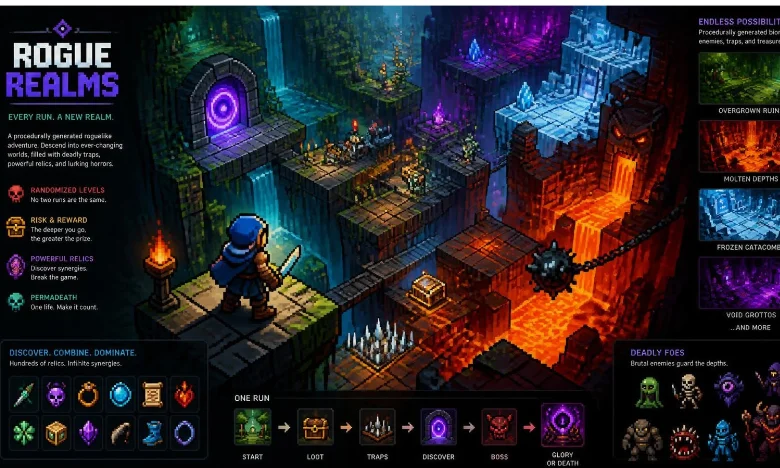
Roguelike games turn failure into a core part of play rather than a simple setback. Each run presents changing challenges, uncertain rewards, and decisions that can quickly end your attempt. Death often sends you back to the beginning, but your knowledge stays with you. That loop makes the genre demanding, replayable, and surprisingly rewarding.
Quick answer: Roguelike games are run-based titles inspired by the 1980 game Rogue. Traditional examples feature procedurally generated environments, permanent death, turn-based actions, and grid-based movement. Modern interpretations often change those rules while keeping randomized runs, meaningful failure, and repeated attempts at their center.
Key Facts at a Glance
| Feature | What it means |
| Genre origin | Inspired by Rogue, released in 1980 |
| Core structure | Repeated runs with changing challenges |
| Procedural generation | Levels, enemies, items, or events can change between attempts |
| Permadeath | Losing can end the current character or run |
| Traditional combat | Usually turn-based and grid-based |
| Modern variations | Action, cards, platforming, shooting, and other formats |
| Player progression | Often based on knowledge, skill, or permanent upgrades |
| Popular examples | Rogue, NetHack, Hades, FTL, and Slay the Spire |
What Are Roguelike Games?
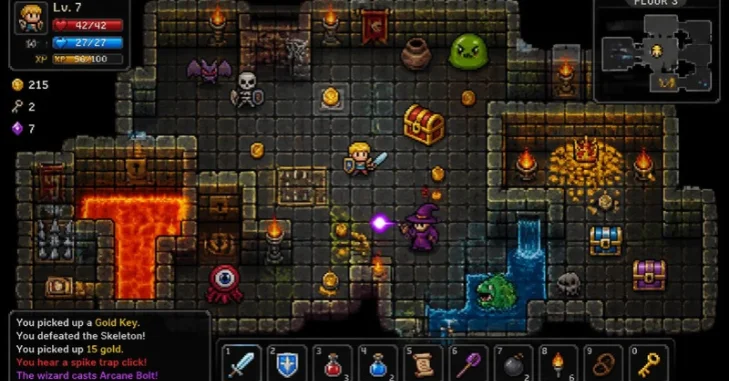
The roguelike games genre traces its name to Rogue, an influential dungeon crawler released around 1980. It presented changing dungeon layouts and punished death by forcing players to begin again. Those ideas influenced numerous later games and eventually produced a recognizable design tradition.
Traditional examples usually combine procedural generation, turn-based actions, grid movement, resource management, and permanent character death. Procedural generation means the game can rearrange important elements between attempts. You cannot depend on memorizing one fixed level from beginning to end.
This structure changes how players think about progress. Finishing one room or collecting strong equipment does not guarantee long-term success. Learning enemy behavior, resource values, and effective tactics becomes equally important.
The definition has become broader as developers have adapted these mechanics to other genres. Real-time combat, deckbuilding, platforming, and shooting can now appear within the same general family. This expansion also explains why the terms “roguelike” and “roguelite” often cause confusion.
Why Permadeath Changes the Experience
Permadeath creates consequences that ordinary checkpoints cannot fully reproduce. A poor choice can destroy a promising attempt and remove equipment collected during that run. Players therefore have a reason to consider risk before entering another fight.
That pressure can make ordinary decisions surprisingly interesting. A low-health player might avoid an optional encounter despite its attractive reward. Another player might accept the danger because one powerful item could transform the run.
Failure also becomes a teaching system. You discover which enemies demand caution and which resources deserve priority. Future attempts become stronger because your understanding improves, even when the character starts weak again.
Procedural Generation Keeps Runs Unpredictable
Procedural generation uses rules to create or arrange game content during play. Developers can randomize rooms, maps, enemies, equipment, rewards, or encounters. Implementation varies widely across titles.
Randomization helps prevent every attempt from becoming an identical sequence. A weapon that dominated one run might never appear during the next. Players must adapt their plans instead of following one perfect route.
Good procedural systems still need deliberate design. Pure randomness can produce frustrating situations rather than meaningful choices. Strong titles use controlled variation to create surprises while keeping the rules clear.
That combination helps explain the genre’s replay value. Players know the basic systems but cannot predict every challenge ahead. Each restart creates another opportunity to apply familiar knowledge to a different situation.
Roguelike vs. Roguelite: What Is the Difference?
The two terms overlap in everyday gaming discussions, but they describe different approaches. A traditional roguelike closely follows design ideas associated with Rogue. A roguelite borrows selected mechanics while relaxing other restrictions.
| Feature | Traditional roguelike | Roguelite |
| Procedural generation | Usually central | Usually central |
| Permadeath | Strong or complete | Often softened |
| Turn-based play | Common | Not required |
| Grid movement | Common | Not required |
| Permanent upgrades | Usually limited | Often important |
| Other genres mixed in | Less common | Extremely common |
Persistent progression is one useful way to understand the difference. Many roguelites let you unlock abilities, weapons, characters, or statistical improvements between runs. Your next character can therefore begin with advantages earned through earlier failures.
Traditional designs often place more weight on player knowledge instead. The character may lose almost everything, while you remember how the systems behave. The boundary remains debated, so storefronts and players frequently use the terms interchangeably.
Why These Games Can Feel Difficult at First
New players can find repeated failure discouraging because most games teach us to protect progress. This genre often asks you to accept losing hours of temporary gains. The change in expectations can be harder than the controls themselves.
Treat each early run as practice rather than a serious attempt to finish everything. Learn one enemy, weapon, card, or system at a time. Small discoveries often provide more lasting value than temporary equipment.
Resource management also deserves attention. Spending every healing item immediately can leave you helpless later. Saving everything can be equally harmful if you die before using valuable tools.
Patience matters because randomness never removes decision-making entirely. Strong players learn to make useful choices with imperfect options. That skill develops through repeated attempts, not one flawless run.
Popular Types You Can Try
The category now reaches far beyond traditional fantasy dungeon crawlers. Players can find card games, action titles, strategy experiences, platformers, and shooters built around repeated randomized runs. This variety makes the format accessible to people with different gaming preferences.
Traditional dungeon crawlers emphasize tactical movement, resources, exploration, and dangerous encounters. Games such as NetHack represent the older design philosophy closely. They suit players who enjoy careful decisions more than fast reflexes.
Action roguelites replace turns with real-time combat and movement. Hades is a prominent example because it combines repeated escape attempts with persistent story development. Its structure can feel more approachable to players familiar with action games.
Deckbuilding titles make cards the primary tools for combat and strategy. Slay the Spire combines randomized encounters with deck construction during each attempt. Players must decide which cards strengthen their strategy without making the deck unnecessarily inconsistent.
Strategy and simulation hybrids use randomized situations rather than traditional dungeon layouts. FTL: Faster Than Light sends players across changing space sectors while managing a vulnerable ship and crew. Its decisions can matter as much as direct combat.
You can explore more gaming features through the Technoloss Gaming section. Readers interested in older game design can also read the site’s arcade games explainer. Both provide useful context for how game formats create replay value.
How to Choose Your First Roguelike
Start with the type of gameplay you already enjoy. Action fans may prefer a real-time title, while strategy players may enjoy cards or turn-based movement. Familiar mechanics make the unusual restart structure easier to learn.
Next, consider how much progress you want to retain after death. Permanent unlocks can make unsuccessful attempts feel more productive. A stricter design provides higher stakes because knowledge may be your main lasting reward.
Session length matters too. Some titles support short attempts that work well during brief gaming sessions. Others encourage longer runs where losing can carry a greater emotional cost.
PC players should also check hardware requirements before buying newer releases. Keeping graphics and system software current can help avoid unrelated performance problems. Technoloss has a practical guide on updating drivers safely.
Why the Formula Remains Popular
The strongest appeal comes from combining familiarity with uncertainty. You understand more after each attempt, but the next run can still surprise you. That creates a natural reason to play again without requiring identical repetition.
Random rewards can also produce memorable combinations. An ordinary item might become powerful when paired with the right ability or card. Discovering those interactions encourages experimentation rather than relying on one strategy forever.
The structure also fits modern gaming schedules well. A run provides a clear beginning and ending without requiring endless commitment. You can stop after one attempt or keep going for a better result.
Start With the Style You Already Enjoy
You don’t need to start with a decades-old dungeon crawler to understand this genre. Pick an action, card, strategy, or turn-based title that matches your existing tastes. Familiar mechanics will help you focus on learning how runs, randomness, and failure work together.
The key is to change how you measure progress. A failed attempt can still teach you an enemy pattern or reveal a useful combination. Once that learning loop feels rewarding, starting over becomes part of the appeal rather than a punishment.
Roguelike Games FAQ
What makes a game a roguelike?
Roguelike games traditionally use procedural generation, permadeath, turn-based actions, and grid-based movement. They trace their design heritage to Rogue. Modern usage is broader, so some titles carrying the label follow only part of that traditional formula.
What does permadeath mean?
Permadeath means a character’s death has lasting consequences rather than triggering a normal checkpoint reload. In stricter titles, death ends the entire run. The player then begins another attempt with little or none of the previous character’s progress.
Are roguelikes always randomly generated?
Procedural generation is one of the most widely recognized features of the genre. The entire game does not need to be random, though. Developers usually combine designed rules with changing layouts, encounters, items, or rewards.
Is Hades a roguelike or roguelite?
Hades is commonly described as a roguelite because meaningful progression survives between escape attempts. Its real-time combat also differs from traditional turn-based design. The game still uses repeated runs and randomized elements associated with the broader genre.
Are these games good for beginners?
They can be, especially when the game offers clear tutorials and progression between attempts. Beginners should expect failure to be part of learning rather than evidence they are playing incorrectly. Choosing a style with familiar combat or controls can make the first few hours easier.