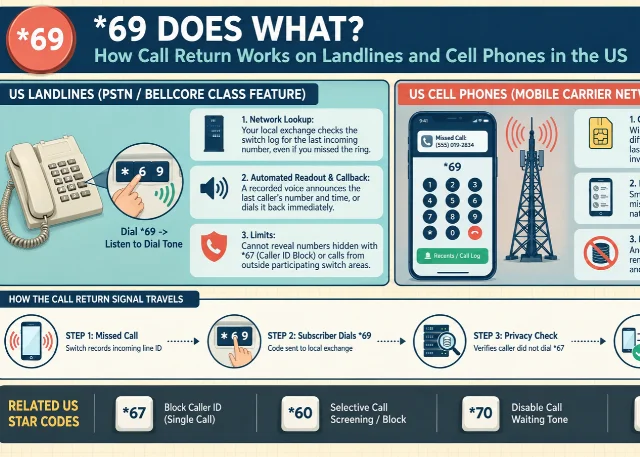
If you’re wondering “*69 does what,” the short answer is simple. It activates a phone feature commonly called Call Return or Last Call Return. On supported US phone services, it can identify or call back the most recent incoming caller.
The feature is mainly associated with landlines and certain digital phone services. Its exact behavior depends on your carrier, location, and phone service. Modern cell phones often make the feature unnecessary because they already keep detailed call histories.
Quick answer: *69 is a US phone code commonly used for Call Return. On supported services, dialing it can provide information about your most recent incoming call or let you call that number back. It does not reliably reveal intentionally blocked numbers, and support varies among landline, wireless, and VoIP providers.
| Question | Quick answer |
|---|---|
| What is *69 called? | Call Return or Last Call Return |
| What does it target? | Your most recent incoming call |
| Does it still work? | Yes, on many supported services |
| Does it work on every cell phone? | No |
| Can it reveal a private number? | Usually not |
| Can it cost money? | Possibly, depending on your plan |
| Is it the same as *67? | No |
| Common cancellation code | *89 on some landline services |
Key Takeaways
- *69 is mainly a Call Return feature.
- It deals with the last incoming call, not your last outgoing call.
- Landline and digital-home-phone support remains common.
- Wireless support depends on the carrier and service.
- Private or unavailable numbers may not be returned.
- Caller ID spoofing can make an announced number misleading.
- Charges can depend on your carrier and calling plan.
- Your smartphone’s recent-call list is often the easier alternative.
What Does 69 Do When You Dial It?

69 Does What? On a supported service, dialing the code asks the phone network about your latest incoming call. The network may announce the associated telephone number. It may then offer an option to return that call.
Verizon currently describes the feature as Call Return on its supported home-phone services. Depending on the service area, users may also hear the call’s date and time. AT&T likewise lists *69 as the code for returning the most recent incoming call.
The exact sequence can differ between phone providers. One service may announce a number before offering a callback. Another may start returning the call with fewer prompts.
How to Use 69 Does What
Using Call Return is usually simple when your phone provider supports it. You should use the same telephone line that received the incoming call. Try the following sequence after the call ends.
- Pick up the phone or open its dialer.
- Dial *69.
- Start the call if your device requires a Send button.
- Listen for the carrier’s recorded instructions.
- Follow the prompt if you want to return the call.
- Hang up if you don’t want to continue.
Some landline services can keep trying when the returned number is busy. AT&T documentation describes systems that may retry for a limited period. Verizon has also documented automatic return features on supported traditional services.
Don’t assume every provider uses the same procedure. Feature availability can vary by service type and geographical area. Check your carrier’s current documentation if the code produces an error.
Does 69 Still Work in the United States?
Yes, the feature still exists on supported US phone networks. Verizon currently lists *69 among its home-phone star codes. AT&T also lists Call Return in its home-phone calling features.
That does not mean every American phone line supports it. Traditional landlines, digital home-phone systems, business systems, and mobile networks use different calling platforms. A code available on one line can fail on another.
This distinction matters if you try the feature from a smartphone. Your mobile carrier may expect you to use the Phone application’s recent-call screen instead. That method also gives you access to more than one recent caller.
Does *69 Work on Cell Phones?
There is no safe universal answer for every US mobile carrier. Star-code support depends on the wireless provider and its network configuration. A feature working on one phone does not prove another carrier supports it.
For most smartphone users, the recent-call list is the easier option. Open your Phone app and find the incoming call under Recents or Call History. You can then tap the entry to call it back.
This approach also avoids one major Call Return limitation. The traditional feature focuses on the latest incoming call. A modern call history can display several recent numbers and timestamps.
If you’re unsure which mobile line your device is using, see our guide to finding your own phone number on iPhone and Android. It covers SIM, eSIM, carrier-account, and device-setting methods. That can help when a dual-SIM phone makes call behavior confusing.
Can *69 Reveal a Blocked or Private Number?
Usually, you should not treat Call Return as a tool for exposing hidden callers. Verizon says its traditional service cannot announce or return calls marked private. AT&T guidance also warns that Call Return may fail with private calls.
The phone network may have technical information that your caller-ID display never receives. That does not mean the service will disclose that information to you. Carrier privacy rules and network configuration affect what you hear.
You should also remember that a displayed telephone number may not prove who called. Caller-ID information can sometimes be manipulated or spoofed. Technoloss explains legitimate and improper uses in its guide to caller ID spoofing.
Does *69 Tell the Other Person You Used It?
The callback normally arrives like another telephone call. Call Return is a network feature used before the connection reaches the other person. The recipient generally does not need a special feature to receive your callback.
Your normal outgoing caller-ID settings can still matter. The person you return the call to may see the number your service sends. Using Call Return itself should not be confused with caller-ID blocking.
That distinction is useful because star codes can perform unrelated jobs. Similar-looking numbers do not necessarily control similar features. You should check the purpose before dialing an unfamiliar code.
69 vs. 67: What Is the Difference?
These two codes have different purposes in the United States. Call Return deals with an incoming call you already received. Caller-ID blocking affects an outgoing call you are about to make.
| Code | Common purpose | What it changes |
|---|---|---|
| *69 | Call Return | Helps return the latest incoming call |
| *67 | Caller ID blocking | May hide your caller ID for one outgoing call |
| *70 | Cancel Call Waiting | Temporarily disables Call Waiting on supported lines |
| *72 | Call Forwarding | Sends incoming calls to another number |
| *57 | Call Trace | Used on supported services for certain unwanted calls |
AT&T and Verizon publish several of these star codes for supported home-phone services. Their lists also show why users should not assume every star code performs the same task. Availability can differ by carrier and account.
What If 69 Does Not Work?
A failed attempt does not necessarily mean your telephone is broken. Your carrier may not support the feature on that service. Your plan may also use another system for handling recent calls.
Start by opening your phone’s call history if you use a smartphone. Landline customers can check their provider’s feature list or account information. Digital voice customers should check instructions for their specific service.
The last caller can also affect the result. Private numbers, unsupported call types, or unavailable caller information may prevent a successful return. Verizon specifically warns that not every incoming call can be announced or returned.
If you’re also experiencing communication problems, don’t assume the star code caused them. Messaging and calling features use different systems. Our guide to the “message blocking is active” error can help if your problem involves failed texts.
Can Using 69 Cost Money?
A charge is possible because Call Return is a carrier-provided service. AT&T notes that some calling features can require subscriptions or usage fees. Long-distance charges may also apply when a returned call falls outside your included calling area.
Do not rely on an old online price for your account. Phone plans and legacy landline services vary widely across the United States. Your provider’s current rate information is the safest place to verify charges.
Smartphone call-history features normally provide another way to identify a recently displayed number. Calling that number can still use your normal plan minutes or international rates. The callback method does not remove ordinary calling charges.
When Should You Avoid Calling Back?
An unfamiliar missed call does not always deserve an immediate response. Scammers can spoof caller ID to display numbers they do not control. Returning a suspicious call can also confirm that your line is active.
Check whether the caller left a legitimate voicemail first. Search for the organization’s official contact details if the caller claimed to represent a company. Contact the organization through its published number instead of trusting an unexpected callback request.
Threatening or repeated unwanted calls require more care. Save call records, voicemails, dates, and other useful evidence. Contact your carrier or appropriate authorities when a call involves credible threats or ongoing harassment.
Better Alternatives on Modern Smartphones
Your call history should usually be the first place to check on an iPhone or Android device. It can show several recent calls rather than only the latest one. It may also display timestamps and saved contact information.
Voicemail is another useful source of context. A legitimate caller may identify themselves and explain why they called. Visual voicemail can make this process faster on supported devices.
Carrier applications and account portals can sometimes provide additional calling information. Business phone systems may offer even richer logs. Use those tools before relying on random “secret phone code” claims found online.
The Bottom Line
Call Return remains useful on phone services that still support it. It can help identify or reconnect with the latest incoming caller. Its behavior is controlled by the carrier rather than by a universal smartphone setting.
For most mobile users, checking the recent-call list is simpler. It provides more history and requires no carrier code. Landline users can still find the older network feature useful after a missed call.
Before returning an unknown call, consider whether the number looks trustworthy. Private calls, spoofed caller IDs, and unsupported networks can limit what the feature tells you. When in doubt, verify the caller through a reliable source before responding.
Frequently Asked Questions
*69 does what on a phone?
It activates Call Return on supported phone services in the United States. The network can identify information tied to your most recent incoming call. Depending on the provider, it may also let you return that call.
Does the code call the last person I called?
No, its traditional purpose concerns the most recent incoming caller. Last-number redial for outgoing calls can use another feature or code. For example, some Verizon services identify *66 as a repeat-dialing feature.
Will it show a No Caller ID number?
You should not count on that result. Official Verizon information says private calls cannot be announced or returned through its traditional feature. Other providers can impose similar limitations.
Can I use it after several people have called?
The traditional service is based on your most recent incoming call. A newer call could therefore replace the caller you wanted to return. Smartphone call history is better when you need to review several calls.
What turns Call Return off?
Some supported home-phone systems use *89 to cancel Call Return requests. Both AT&T and Verizon publish that code for certain services. Your own carrier’s instructions should take priority.